


Key Takeaways

Germany's SMEs face a projected skilled worker gap of 768,000 by 2028, making hiring an insufficient strategy.
Successful AI integration is an organizational design challenge, not a tech problem; you must clarify human roles before adding AI agents.
A structured 4-step process (Identify, Prioritize, Group, Hand Over) allows SMEs to integrate AI agents effectively and solve labor shortages from within.
The skilled worker shortage is no longer a future threat; it's a daily reality for Germany's Mittelstand. With 27.2% of SMEs reporting that a lack of staff is hurting their business, the pressure is immense. Many leaders feel trapped in an endless cycle of recruiting, but the demographic shift means we can't hire our way out of this problem. The answer lies in a radical rethinking of our team structures. By integrating AI agents as teammates-what we call building Hybrid Teams-you can automate routine tasks, amplify your current team's capabilities, and build a more resilient organization. This isn't about replacing humans; it's about preparing your team for the agentic age.
The Unwinnable Race for Talent in Germany's Mittelstand
The numbers paint a stark picture for German SMEs. The German Economic Institute forecasts a gap of 768,000 skilled workers by 2028, a significant jump from 487,000 in 2024. This isn't a temporary dip; it's a structural crisis driven by an aging workforce. For Team Architects, this translates into constant overload, with critical projects stalling because over 35% of service providers simply can't find the right people. This persistent shortage creates a vicious cycle. Existing team members absorb the extra workload, leading to burnout and decreased performance. Innovation suffers because everyone is stuck in operational firefighting, a reality for nearly one-third of all German companies. The traditional approach of simply posting another job opening is a strategy with diminishing returns, forcing a necessary shift in workforce transformation.
AI Adoption Is Accelerating, But SMEs Are Being Left Behind
While the labor crisis deepens, an AI revolution is gaining speed. About 91% of German companies now view generative AI as critical to their business model. Yet, a major gap exists between large corporations and SMEs. While 56% of large companies actively use AI, only 38% of small and medium-sized businesses do the same. This creates a dangerous competitive disadvantage for the backbone of the German economy. The primary barrier isn't a lack of ambition; it's a lack of clarity and resources. Many SMEs are paralyzed by the complexity, with 30% admitting they don't know which tools to use. This hesitation prevents them from tapping into AI's potential to solve the very labor shortages that threaten their growth. The key is not just adopting technology, but fundamentally rethinking role-based work.
The Real Solution: It's Not About the Bots, It's About the Team
Integrating AI successfully is not a technology problem; it's an organizational design challenge. You cannot layer expensive AI agents onto chaotic human processes and expect good results. The foundation for effective human-AI collaboration is absolute clarity on who does what, why, and with whom. This is the prerequisite for AI adoption.
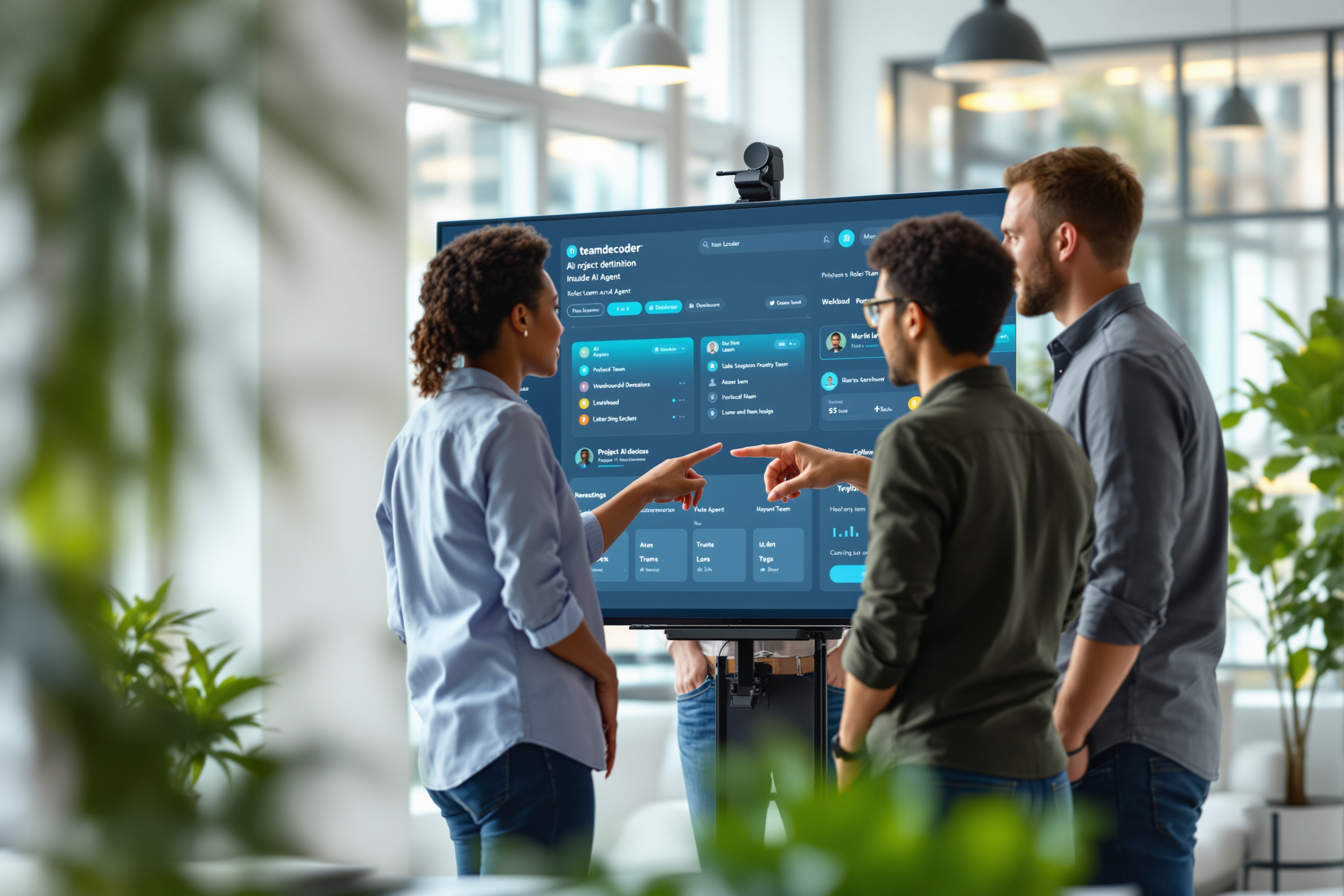
At teamdecoder, we define a Hybrid Team as one where humans and AI agents work side-by-side as colleagues. The OECD found that among SMEs using generative AI, 39% reported it helped them compensate for skill gaps. To achieve this, you must first tidy up your human roles to create a clear "landing strip" for your new AI teammates. This approach turns the abstract idea of AI integration into a concrete, manageable process. You can even try teamdecoder for free to start mapping your team structure today.
Architect Insight: The 4-Step Hybrid Team Planner
To move from theory to practice, Team Architects need a repeatable framework. Our Hybrid Team Planner provides a structured, four-step process for integrating AI agents effectively.
Deep Dive: Your AI Integration Roadmap
This process removes the guesswork and focuses on targeted, high-impact AI implementation.
- Identify AI-Suitable Tasks: Analyze your team's workflows to find repetitive, data-heavy, or administrative tasks. These often consume up to 25% of a skilled employee's time.
- Prioritize and Check AI Fitness: Not all tasks are created equal. Use a simple scoring matrix to rate tasks based on their potential for time savings and their suitability for current AI capabilities. Focus on the top 2-3 tasks first.
- Group Tasks into AI Role Buckets: Bundle related tasks into a logical "role" for an AI agent. For example, group "generate weekly sales report," "transcribe meeting notes," and "draft follow-up emails" into an "Admin Support Agent" role.
- Hand Over and Supervise: Assign the task bucket to a specific AI tool or platform. The human team member then transitions from *doing* the task to *supervising* the AI agent's output, saving them 5-10 hours per week.
Our Playful Tip:
Start with a single, low-risk workflow. Choose a process that annoys at least three people on your team. Solving a shared frustration provides a quick win and builds momentum for broader AI integration and mastering constant change.
How It Works with teamdecoder: Building Your AI-Ready Team
The teamdecoder platform is designed to make this transition seamless. Our AI Role Assistant helps you identify tasks within existing roles that are prime candidates for automation, flagging activities that take up over 15% of a role's time but are low-value. You can visually map out your current team structure and see exactly where an AI agent could have the biggest impact.
Using our Workload Planning feature, you can quantify the time savings. For instance, you can model how offloading 8 hours of reporting per week from a Senior Engineer (a 0.2 FTE reduction in that task) frees them up for high-value innovation. This provides the data you need to make a compelling business case for investing in specific AI agents, transforming your approach to strategy operationalization.
Real-World Application: From Overload to Opportunity
Consider a typical mid-sized consulting firm struggling to keep up with client demand. Their team of 15 consultants spends nearly 20% of their billable hours on non-billable tasks like research summaries, presentation formatting, and data entry. Hiring more consultants is difficult due to the tight labor market, with over 64% of professional services firms facing shortages. By applying the Hybrid Team model, the firm identifies these administrative tasks and bundles them into a role for an AI agent. The AI handles the first draft of research reports and standardizes slide decks, saving each consultant an average of 6 hours per week. This single change frees up 90 hours of high-value consulting time weekly, allowing the firm to serve 2-3 more clients without hiring a single new person. Team well-being improves as consultants focus on the strategic work they love.
Getting Started on Your Human-AI Team Journey
You can begin solving your labor shortage challenges today without a single job posting. It starts with bringing clarity to your existing team structure. Here are five steps to get you started:
- Map Your Current Team Structure: Use a tool to visualize all roles and the key tasks within them.
- Identify Bottlenecks and Overloads: Pinpoint which roles are consistently working over their 1.0 FTE capacity.
- Run the 4-Step Hybrid Team Planner: Start with one overloaded role and identify tasks to hand over to an AI agent.
- Create Your Free teamdecoder Account: Use our AI Role Assistant and Workload Planning tools to model the impact.
- Run Your First Campfire Session: Guide your team through the changes collaboratively to ensure buy-in and smooth adoption.
---
Try teamdecoder for free - shape your team and make change feel like play!
#Team Architecture #HybridTeam #WorkforceTransformation #AIIntegration
More Links
The German Federal Statistical Office provides statistics and information on skilled workers in Germany's labor market.
The Centre of Excellence for Skilled Labour (KoFa) offers an overview of the skilled worker shortage in Germany, including relevant data and facts.
The Association of German Chambers of Industry and Commerce (DIHK) presents its 2023 skilled worker report, containing data and analysis on the current labor situation.
The Mittelstand-Digital Initiative offers a 2023 study on AI, focusing on its adoption and impact on small and medium-sized enterprises (SMEs) in Germany.
The Bavarian Research Institute for Digital Transformation (BIDT) monitors trends and developments in AI adoption within German SMEs, with a focus on 2025.
The Institute for Employment Research (IAB) discusses the potential effects of artificial intelligence on the German labor market.
The Fraunhofer Society explores human-centered AI and its role in the modern workplace.
Bitkom, Germany's digital association, addresses the digital transformation of SMEs (Mittelstand) in Germany.
KfW, a German state-owned development bank, provides information on funding and support for innovation and digitalization for companies in Germany.
FAQ
Will AI replace jobs in our company?
The goal is not to replace jobs but to augment them. By handing over routine tasks to AI agents, you empower your employees to focus on more valuable and engaging work that requires human creativity and critical thinking. This helps solve labor shortages by increasing the capacity of your current team.
Is integrating AI expensive for an SME?
While some AI solutions can be costly, many scalable, cloud-based AI services are affordable for SMEs. The key is to start small with a clear use case that delivers a high return on investment, such as automating a task that consumes 10+ hours of employee time per week. The productivity gains often quickly outweigh the cost.
Our team has no AI experts. How can we get started?
You don't need to be an AI expert to begin. The first step is organizational, not technical. Use a platform like teamdecoder to clarify your team's roles and identify repetitive tasks. This structured approach prepares you to select the right user-friendly AI tools for specific needs, without requiring an in-house data scientist.
How do we ensure our data is secure when using AI?
Data security is a valid concern. It's essential to choose reputable AI vendors who are compliant with GDPR and other regional data protection laws. Start by using AI for tasks that do not involve sensitive personal or client data to build confidence and establish secure processes.