

Key Takeaways

Digital tools for organizational design workshops replace static, analog methods with persistent, collaborative, and data-driven environments.
Key features of effective tools include dynamic role mapping, strategic alignment frameworks, AI assistance, and scenario planning.
Using a structured digital platform like teamdecoder can reduce role confusion, prevent team overload, and create a single source of truth for workforce transformation.
Running an organizational design workshop can feel like trying to build a ship in a bottle during a storm. Ideas are everywhere, energy is high, but the process is fragile and the outcomes are hard to capture. A staggering 70% of transformations fail to achieve their goals, often due to a lack of clear roles and follow-through. Digital tools for organizational design workshops offer a new way forward, transforming chaotic brainstorming into structured, actionable plans. They provide a single source of truth that helps operationalize strategy and empowers Team Architects to guide change with precision and clarity.
Breaking Free From Analog Constraints
For decades, the core toolkit for organizational design workshops has been analog: walls covered in sticky notes, sprawling whiteboard diagrams, and stacks of flip charts. While these methods facilitate face-to-face brainstorming, they have significant limitations. A 2021 Fraunhofer IAO study notes that while personal interactions are essential for creativity, purely analog methods make data difficult to preserve and analyze. Information is often lost in transcription, and insights from a 3-hour session can vanish once the notes are taken down. This creates a critical strategy-execution gap where great ideas fail to become operational realities. These traditional workshops struggle to include remote participants effectively, limiting input from a workforce where over 60% of employees may have flexible work arrangements. This lack of a persistent, shared workspace hinders the continuous nature of modern team architecture.
The Rise of Digital Facilitation Platforms
The shift to digital is reshaping how teams collaborate on complex challenges like organizational design. According to a 2024 Bitkom report, 81% of German companies now use cloud computing, with 48% specifically using collaboration tools to enhance teamwork. These platforms are more than just digital whiteboards; they are integrated environments for structuring conversations and decisions. They provide a persistent digital space where progress is saved, versioned, and accessible to all stakeholders 24/7. This approach supports the 9-to-5 workday and asynchronous contributions from team members across different time zones. Using digital visualization tools allows for dynamic modeling of team structures, a task nearly impossible with static paper charts. This evolution is critical for managing the constant change that defines modern business.
Core Capabilities of Modern Org Design Tools
Deep Dive: The Team Architect's Digital Toolkit
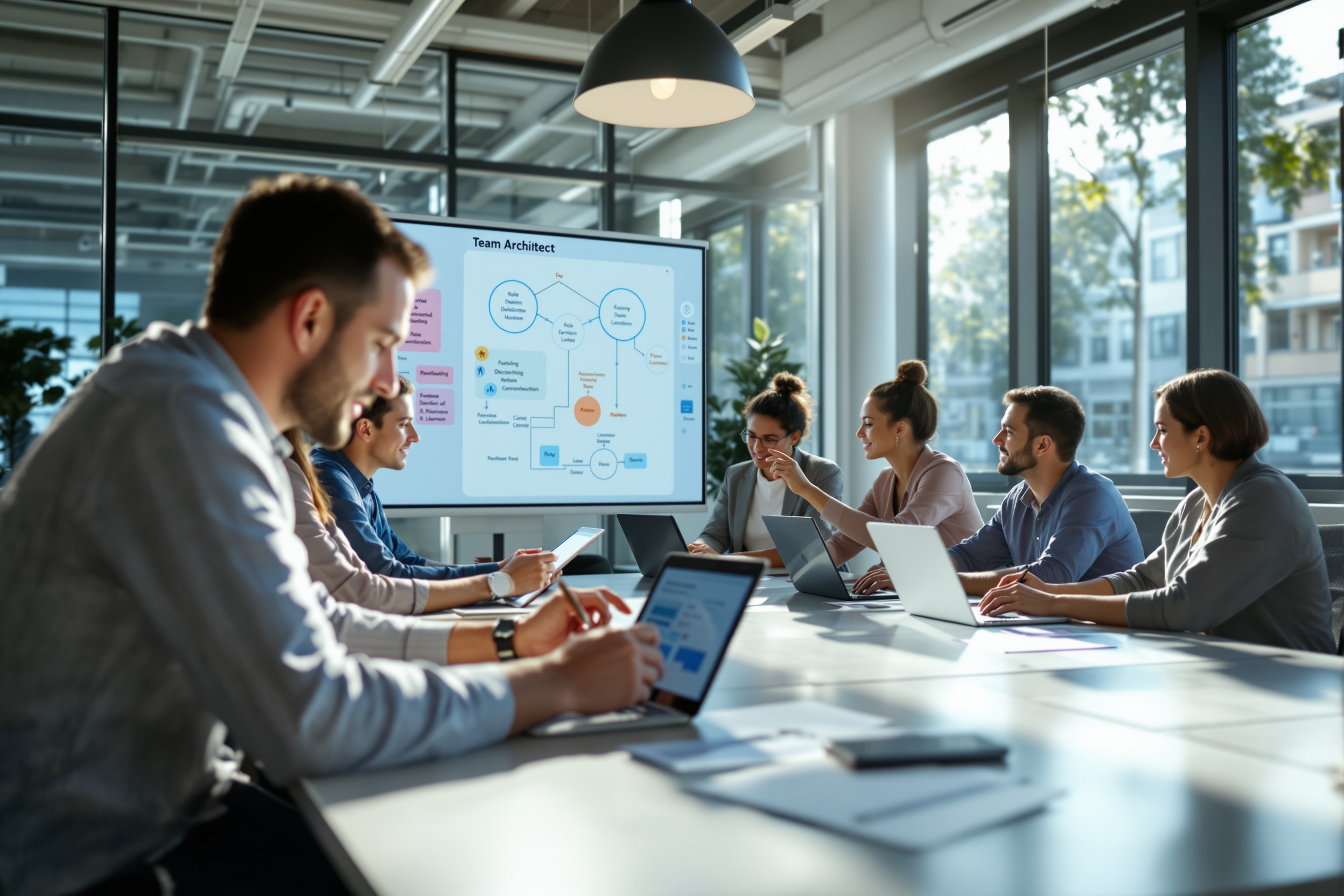
Effective digital tools for organizational design workshops go beyond simple drawing functions. They offer a suite of integrated features designed to guide a team from abstract ideas to a clear, operational structure. Team Architects should look for platforms that provide these four key capabilities:
- Dynamic Role & Responsibility Mapping: Tools that allow you to define roles, assign responsibilities, and visualize workloads in real-time. This helps solve the primary pain point of role confusion.
- Strategic Alignment Frameworks: Features like a Purpose Tree that connect individual roles and team tasks directly to high-level corporate objectives, ensuring every action supports the overall strategy.
- AI-Powered Assistance: An integrated AI Role Assistant can accelerate brainstorming by suggesting tasks, skills, and responsibilities for new or evolving roles, reducing manual effort by up to 30%.
- Collaborative Scenario Planning: The ability to model different organizational structures and compare them side-by-side. This allows teams to test hypotheses and make data-informed decisions before implementation.
These features transform a workshop from a simple meeting into a productive design session, ensuring that outcomes are both clear and actionable for everyone involved in the transformation framework.
How teamdecoder Powers Data-Driven Workshops
teamdecoder is built specifically for Team Architects who need to facilitate complex organizational change. Instead of a blank canvas, it provides a structured environment for defining 'who does what, why, and with whom'. During a workshop, you can use the AI Role Assistant to rapidly prototype new roles, cutting down initial drafting time significantly. The platform's Circle and Project views allow for the instant visualization of how teams and roles interact, making abstract structures tangible for all participants. This clarity helps reduce the 50% of employee time often wasted on navigating unclear reporting lines and responsibilities. By using the Workload Planning feature, facilitators can immediately assess the impact of proposed changes on individual capacities, preventing team overload before it happens. This is how you solve role confusion with precision.
Application Scenario: Restructuring for AI Integration
Consider a mid-sized German manufacturing firm preparing to integrate AI agents into its supply chain team-a classic hybrid team transformation. Before teamdecoder, their workshop was a series of confusing meetings that ended with 15 pages of conflicting notes. Using a digital platform, the Team Architect guided a 4-hour session where they mapped the entire existing workflow. They then used the Hybrid Team Planner to identify over 20 repetitive tasks suitable for AI handover. The team visualized a new structure where human roles were elevated to focus on strategy and exception handling, increasing value-added work by 25%. The final output was not a document but a live, interactive model of the new team structure, serving as a single source of truth for the entire organization.
Getting Started With Your First Digital Workshop
Transitioning from analog to digital methods can be done in five manageable steps. A 2022 Bitkom study found that 83% of companies now have a digitization strategy, and improving your workshop is a perfect place to start. This structured approach ensures a smooth and effective transition for your team.
- Define Clear Objectives: Identify the top 1-3 outcomes you need from the workshop, such as clarifying roles for a new project or redesigning a department.
- Choose the Right Tool: Select a platform that offers structured features for role definition and workload planning, not just a blank canvas.
- Onboard Participants Early: Give team members access to the tool 2-3 days before the workshop to familiarize themselves with the interface.
- Structure the Agenda: Use the tool's features to guide the conversation, from brainstorming roles with an AI assistant to mapping workflows.
- Capture and Share a Living Plan: End the workshop with a clear, interactive model of the new team design that can be updated as the transformation progresses.
You can explore these steps and more by taking an interactive app tour of a dedicated platform.
More Links
German Federal Ministry of Labour and Social Affairs (BMAS) discusses the digitalization of the working world.
German Federal Statistical Office (Destatis) provides a press release likely containing statistical data relevant to the German economy or society.
Fraunhofer IPK discusses the future of cross-company collaboration in the context of industry and technology trends.
acatech (German National Academy of Science and Engineering) discusses the digital transformation of work and the need to engineer employee enthusiasm.
Bertelsmann Foundation offers a publication discussing the future of work, projecting to the year 2050.
KfW discusses digitalization, focusing on its impact on the German economy and businesses.
BVDW e.V. (German Association for the Digital Economy) provides information on its LinkedIn page.
DGFP (German Society for Personnel Management) discusses HR topics, specifically change management and organizational development.
FAQ
Why are traditional workshop methods with sticky notes no longer sufficient?
While useful for brainstorming, sticky notes and whiteboards are inefficient for complex organizational design. Information is easily lost, it's difficult to include remote team members, and the results are not connected to a live, operational system. Digital tools create a persistent, scalable, and actionable single source of truth.
How does an AI Role Assistant help in a workshop?
An AI Role Assistant accelerates the design process by suggesting relevant tasks, skills, and responsibilities for any given role. This reduces the time spent on initial brainstorming and helps teams consider a wider range of possibilities, leading to more comprehensive and well-defined roles.
Can digital tools help with managing constant change?
Yes, this is one of their primary advantages. Unlike a static diagram, a digital organizational model is a 'living document.' It can be updated continuously to reflect new projects, evolving roles, or strategic shifts, making it the perfect tool for managing constant change.
Is teamdecoder suitable for external consultants?
Absolutely. teamdecoder is designed for all Team Architects, including external consultants. It provides a repeatable toolkit and framework that helps consultants deliver faster, clearer results for their clients and provides a living model of the organization that clients can continue to use after the engagement ends.