


Key Takeaways

Shift from project-based 'change management' to a continuous culture of structural evolution to combat change fatigue and increase resilience.
Radical role clarity is the foundation of an adaptive organization, as it reduces the uncertainty that drives employee resistance.
Before integrating AI agents, you must first clarify and structure human roles to create a stable 'landing strip' for successful human-AI collaboration.
The rhythm of business has changed from predictable seasons to a permanent state of flux. Yet, many leaders still rely on outdated, project-based change management, leading to fatigue and failure. A stunning 71% of employees feel overwhelmed by constant workplace changes. This article presents a new model: creating a culture of continuous structural evolution. We will explore how Team Architects can move beyond disruptive reorgs to build agile, role-based systems that adapt fluidly, embedding resilience and performance into the very fabric of their teams.
Snack Facts: The Unmistakable Case for Constant Change
The data on organizational change paints a clear picture of the new reality for Team Architects.
- Nearly 3 out of 4 organizations expect the number of change initiatives to increase.
- Agile companies have a 70% chance of ranking in the top quartile for organizational health.
- Germany's economy faces a potential shortage of 7 million skilled workers by 2035, forcing structural adaptation.
- Up to 70% of transformation projects fail, often due to a lack of employee buy-in.
These numbers signal a fundamental shift from episodic change to a necessary state of continuous evolution.
The Core Problem: Why Traditional Change Management Fails
Traditional change management operates with a fatal flaw: it assumes change has a beginning and an end. This project-based mindset creates a cycle of disruption, causing 41% of employees to resist due to mistrust in the organization. Only 43% of employees believe their company can effectively manage change, highlighting a massive confidence gap. This friction is not a sign of bad employees; it is a symptom of a broken process. The old model of top-down, episodic reorganizations no longer fits a world where team lifecycles are shortening and market demands shift quarterly. This approach creates instability precisely when a stable core is needed most.
The Solution: Shifting to a Continuous Evolution Mindset
The alternative is creating a culture of continuous structural evolution. This means building an organization designed to adapt as a core function, not as a painful exception. A successful agile transformation can deliver 30% gains in efficiency and employee engagement. The key is moving from rigid job descriptions to fluid, role-based work. When roles are clear, transparent, and adaptable, the system can evolve without collapsing. This approach turns the entire team into an active part of the change process. Organizations that involve employees in planning see a 24% higher chance of success. This is the foundation for building resilient teams in the agentic age.
Architect Insight: The 4 Pillars of an Adaptive Team Structure
Deep Dive: The Adaptive Framework
Team Architects can foster continuous evolution by focusing on four operational pillars. Each pillar contributes to a system where change is manageable and expected.
>
- Radical Role Clarity: Every team member must know exactly "who does what, why, and with whom." This reduces the uncertainty that causes 38% of change resistance.
- Living Documentation: Your team structure should be a dynamic map, not a static chart. It must reflect reality in real-time as roles fade in and out.
- Continuous Feedback Loops: Replace annual reviews with frequent, structured conversations about roles and workloads, like teamdecoder's Campfire process.
- Decentralized Ownership: Empower teams to make structural adjustments within their Circles, increasing ownership and speed.
Our Playful Tip:
Start a "role clarity" sprint. For two weeks, begin every meeting with a 1-minute review of the roles present and their accountability for the topics discussed. This simple habit makes structuring teams for success a daily practice.
The Hybrid Team Angle: Structuring for Human-AI Collaboration
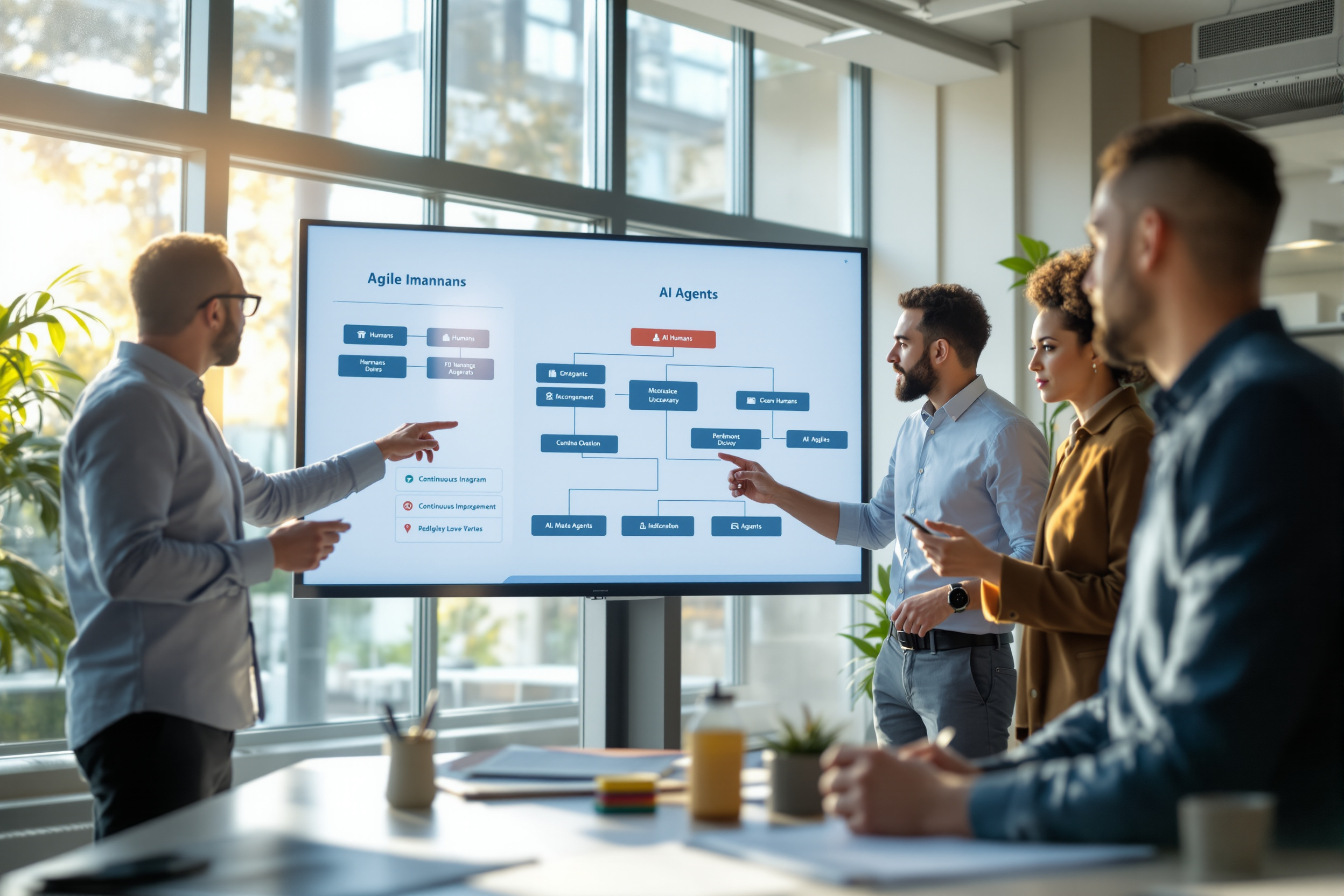
Continuous evolution is the prerequisite for integrating AI agents as teammates. Gartner predicts 1 in 5 companies will use AI to flatten hierarchies by 2026. You cannot layer expensive AI agents onto chaotic human processes and expect success. teamdecoder defines Hybrid Teams as humans and AI agents working side-by-side. This requires first creating a clean "landing strip" for AI by defining human roles with precision. The goal is to identify which tasks an AI can take over, freeing up human capacity by at least 10-15% for higher-value work. This proactive preparation of your team culture is not optional; it is essential for ROI.
How It Works with teamdecoder: Your Toolkit for Evolution
teamdecoder is built to enable continuous structural evolution. The platform moves your team from static charts to a living organizational system. Use the AI Role Assistant to define accountabilities in minutes, not weeks. The Workload Planning view gives you FTE-based clarity to prevent the overload that plagues 86% of younger employees during change. With the Campfire process, you can guide your team through regular, small-scale structural improvements. This makes designing new workflows a collaborative, low-friction habit. You can try teamdecoder for free to see these tools in action.
Real-World Application: From Change Fatigue to Fluid Design
Consider a typical mid-sized agency struggling with growth. Before, every new client win triggered a chaotic reshuffle, with project ownership unclear for weeks. After adopting a continuous evolution mindset, their structure is mapped in teamdecoder. New client roles are planned and assigned in 1-2 days. The Purpose Tree ensures every role connects to strategy, and the Compare Mode helps leaders model changes without disrupting current work. This clarity has led to a 20% reduction in onboarding friction for new projects and improved team resilience.
Getting Started: Your First 5 Steps to an Adaptive Culture
Building this culture is a journey of a thousand small steps, not one giant leap. Here is how you, as a Team Architect, can begin today:
- Map your current team structure and roles to create a baseline of truth.
- Identify the top 3 roles with the most overlap or ambiguity.
- Run your first Campfire session focused solely on clarifying those 3 roles.
- Use the AI Role Assistant to draft clear responsibilities for a new or evolving role.
- Create your free teamdecoder account to anchor these new habits in a dedicated tool.
For more guidance, explore our resources on balancing operations and innovation and avoiding AI rejection.
---
Try teamdecoder for free - shape your team and make change feel like play!
#TeamArchitecture #ConstantChange #OrganizationalDevelopment
More Links
Deloitte discusses the skill-based organization.
Accenture discusses a study that shows a scientific approach doubles the success of change processes.
BearingPoint links to their Agile Pulse 2020 study.
Fraunhofer IAO describes their research area of organizational development and work design.
Fraunhofer IPA links to a study on agile organizations.
German Chamber of Industry and Commerce (DIHK) provides information on topics and positions.
DIW Berlin discusses the functional structural change in the industry and the increasing importance of production-related services.
IW Cologne discusses AI as a competitive factor.
Handelsblatt Research Institute discusses change management at Bayer.
FAQ
How can my team start with continuous evolution without a big budget?
Start small and focus on habits. Begin by mapping your existing team roles for free in a tool like teamdecoder. Then, introduce a recurring meeting (a 'Campfire') to discuss and refine just one or two roles at a time. This builds the muscle of continuous improvement without requiring a large-scale project budget.
Is this approach suitable for large, established companies?
Absolutely. While it sounds like a startup mentality, the principles are about creating stability to enable dynamism. Large companies benefit immensely by applying this to specific departments or 'Circles,' allowing them to become more agile while maintaining a stable corporate backbone. A McKinsey study found agile companies have a 70% chance of being top-quartile performers.
What is the difference between a job description and a role?
A job description is a static, container-like definition of a position. A role is a dynamic, living collection of accountabilities and responsibilities. A single person can hold multiple roles, and roles can be passed between people, making the organization far more flexible than one built on rigid job titles.
How does teamdecoder help with AI integration?
teamdecoder helps you prepare for AI by getting your human team structure in order first. Our platform allows you to clearly define tasks and roles, making it easy to identify which activities are suitable for AI agents. This creates the clear, structured environment necessary for effective human-AI collaboration.