


Menu
Key Takeaways

Strategic alignment is an ongoing process of constant change, not a one-time project, requiring a shift from static job descriptions to dynamic, role-based work.
Hybrid teams (humans + AI agents) require explicit role design to ensure clear accountabilities and seamless hand-offs between human expertise and AI efficiency.
Operationalizing strategy involves mapping every high-level objective to specific roles, ensuring that daily tasks are directly connected to the organization's vision.
Strategic alignment is often treated as a static milestone, a box to be checked during an annual retreat. However, in an era of constant change, alignment must be a continuous process. For Team Architects—those HR leaders and department heads responsible for organizational health—the challenge is no longer just about getting people on the same page. It is about designing a resilient structure where humans and AI agents work in tandem toward a shared vision. When strategy remains at the executive level, it creates a vacuum of clarity that leads to friction and stalled progress. A well-executed strategic alignment workshop serves as the bridge, turning abstract goals into concrete, role-based actions that drive the organization forward.
The Evolution of Alignment in an Era of Constant Change
The traditional model of strategic alignment was built for a world that no longer exists. In that world, leadership would set a three-year plan, cascade it down through departments, and check in quarterly. Today, the pace of technological advancement and market shifts means that strategy is in a state of constant change. According to a 2024 Gartner report, organizational agility is now a top priority for 87% of HR leaders, yet many struggle to move beyond legacy planning structures. Alignment is not a project with a defined end date; it is an ongoing requirement for survival.
For the Team Architect, this means the strategic alignment workshop must evolve from a passive presentation into an active design session. The goal is not just to communicate the strategy, but to operationalize it. This requires a shift from focusing on job descriptions to focusing on roles. Job descriptions are often static and outdated the moment they are signed. Roles, however, are dynamic. They represent specific sets of accountabilities that can be adjusted as the strategy shifts. When a team understands the 'why' behind the strategy, they need the 'how' defined through clear roles to actually execute it.
Deep Dive: The Cost of Misalignment
Misalignment is rarely loud. It manifests as 'shadow work,' where employees spend time on tasks that do not contribute to the core mission, or as 'decision paralysis,' where teams are unsure who has the authority to move a project forward. A 2023 McKinsey report on the state of organizations highlighted that increasing complexity often leads to a lack of role clarity, which is a primary driver of burnout and inefficiency. By using workshops to clarify these roles, Team Architects can reduce this friction and create a more resilient workforce.
Our Playful Tip: Think of your strategy as a living organism rather than a stone tablet. If the environment changes, the organism must adapt. Your workshop is the laboratory where that adaptation is designed and tested.
Defining the Hybrid Team: Integrating Humans and AI Agents
One of the most significant shifts in modern organizational design is the emergence of hybrid teams (humans + AI agents). In this context, 'hybrid' does not refer to where people work, but rather who—or what—is doing the work. As AI agents become more sophisticated, they are moving from simple tools to active participants in workflows. A strategic alignment workshop that ignores the role of AI is incomplete. Team Architects must now consider how AI agents fit into the broader strategic picture and which accountabilities they should hold.
Integrating AI agents requires the same level of role clarity as integrating a new human hire. If an AI agent is responsible for data synthesis or initial customer triage, that role must be clearly defined within the team's architecture. Who oversees the AI? What are the hand-off points between the agent and the human? Without this clarity, the introduction of AI can lead to confusion and a sense of displacement among human team members. The workshop provides a neutral space to map these interactions and ensure that the hybrid team (humans + AI agents) is optimized for the strategy at hand.
Concrete Scenario: The Marketing Hybrid Team
Imagine a marketing department shifting its strategy to hyper-personalized content. In the alignment workshop, the Team Architect identifies a role for an AI agent: Content Researcher. This agent is accountable for scanning trends and generating initial drafts. The human role, Content Strategist, is then redefined to focus on brand voice alignment and emotional resonance. By explicitly defining these roles during the workshop, the team avoids the common pitfall of 'AI anxiety' and instead sees the agent as a partner that enables them to focus on higher-value work.
- Identify tasks that are repetitive or data-heavy for AI agents.
- Define the 'Human-in-the-loop' checkpoints for quality and ethics.
- Ensure every AI agent has a human 'Role Owner' accountable for its performance.
Operationalizing Strategy through Role-Based Work
The biggest gap in strategy execution is often the distance between the boardroom and the desk. Executives speak in terms of market share and EBITDA; employees speak in terms of tasks and deadlines. Role-based work is the language that translates one to the other. During a strategic alignment workshop, the primary objective should be to map every strategic pillar to specific roles. This ensures that the strategy is not just a slide deck, but a functional part of the team's daily operations.
When we talk about role-based work, we are moving away from the hierarchy of 'who reports to whom' and toward a network of 'who is accountable for what.' This is particularly important in distributed teams where visibility into daily tasks might be lower. By defining roles with clear accountabilities, Team Architects provide the autonomy that modern professionals crave while maintaining the alignment the organization needs. This approach allows for faster pivots; if a strategic priority changes, you don't necessarily need to restructure the entire department—you simply update the accountabilities of the relevant roles.
Deep Dive: The Team Architecture Framework
The Team Architecture Framework focuses on three core elements: Purpose, Roles, and Accountabilities. In an alignment workshop, you start with the Purpose (the strategy). Then, you identify the Roles needed to fulfill that purpose. Finally, you define the Accountabilities for each role. This granular approach removes ambiguity. For example, if the strategy is 'Customer Obsession,' a role might be 'Customer Feedback Loop Lead' with the accountability of 'Synthesizing weekly feedback into actionable product requirements.' This is far more effective than simply telling everyone to 'be more customer-focused.'
Our Playful Tip: During the workshop, try the 'Empty Chair' exercise. Place a chair in the middle of the room representing a specific strategic goal. Ask participants to identify which of their roles 'speaks' to that chair. If no one speaks, you have a gap in your architecture.
The Workshop Framework: Preparation and Execution
A successful strategic alignment workshop begins long before the participants enter the room. Preparation is essential for ensuring the session is productive rather than performative. Team Architects should start by gathering data on the current state of the team. This might include role clarity surveys, workload assessments, or feedback on existing bottlenecks. This data provides a baseline and ensures the workshop is grounded in reality rather than just aspirational thinking.
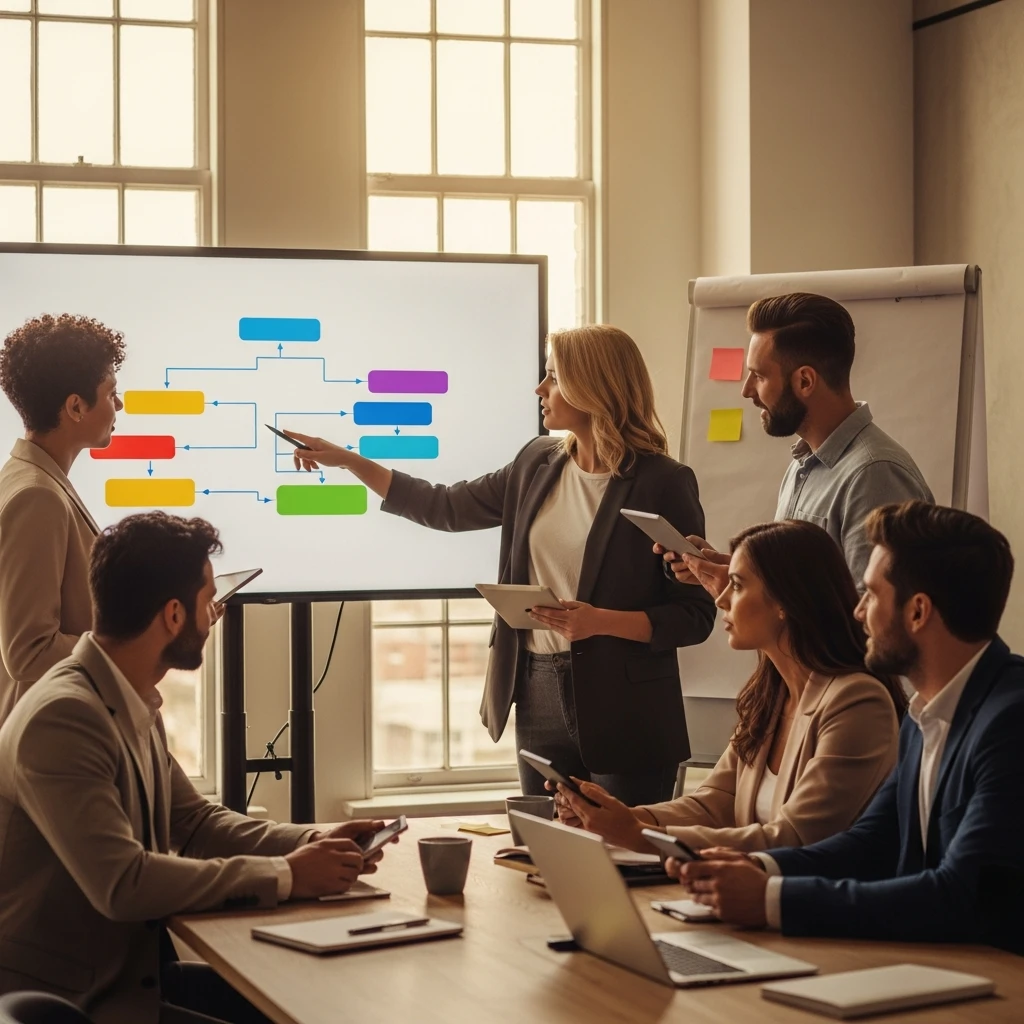
The execution of the workshop should be highly interactive. Avoid long presentations. Instead, use the time for collaborative mapping. Start by clarifying the strategic objectives for the next period. Once the objectives are clear, move into 'Role Storming.' This is where the team identifies the roles required to meet those objectives. This is also the ideal time to introduce the concept of AI agents. Ask the team: 'If we had an AI agent that could handle 20% of our administrative burden, what new strategic roles could we create with that reclaimed time?'
Step-by-Step Workshop Flow:
- Context Setting: Briefly review the strategy and the current organizational landscape.
- Role Audit: Map out existing roles and identify which ones are aligned with the new strategy and which are legacy roles.
- Gap Analysis: Identify what is missing. Do we need new human roles? Can an AI agent fill a gap?
- Accountability Mapping: Define 3-5 clear accountabilities for every role identified.
- Integration Check: Ensure the hand-offs between roles (especially between humans and AI) are seamless.
The output of this session should be a visual map of the team's architecture. This map serves as a living document that guides the team through the ongoing transformation. It provides a clear reference point for decision-making and helps onboard new members—human or AI—into the system with minimal friction.
Common Pitfalls in Strategic Alignment
Even the most well-intentioned workshops can fall flat if they succumb to common organizational traps. One of the most frequent mistakes is 'Alignment Theater.' This happens when a team agrees to a strategy in the room but returns to their old habits the next day. This usually occurs because the workshop focused on high-level goals without addressing the underlying role structure. If the strategy changes but the roles remain the same, the old roles will inevitably pull the team back to the old strategy.
Another pitfall is the 'Over-Complexity Trap.' In an attempt to be thorough, Team Architects might create too many roles or overly detailed accountabilities. This leads to a rigid system that cannot handle the constant change inherent in modern business. The goal is clarity, not bureaucracy. Roles should be defined broadly enough to allow for individual expertise and creativity, but specifically enough to prevent overlap and confusion. Finding this balance is the hallmark of a skilled Team Architect.
Decision Framework: The Clarity vs. Flexibility Matrix
When designing roles during a workshop, use a simple matrix to evaluate them. On one axis is 'Clarity' (how well the role is understood) and on the other is 'Flexibility' (how easily the role can adapt). The 'Sweet Spot' is high clarity and high flexibility. If a role is high clarity but low flexibility, it becomes a silo. If it is high flexibility but low clarity, it becomes a source of chaos. Aim for roles that have clear 'What' (accountabilities) but flexible 'How' (execution methods).
Our Playful Tip: Watch out for 'Role Creep.' This is when a role slowly accumulates accountabilities that don't belong to it. During your workshop, give everyone a 'Role Eraser'—the permission to remove one accountability that no longer serves the strategy. It's often more important to decide what you *won't* do than what you will.
Decision Frameworks for Team Architects
To navigate the complexities of organizational design, Team Architects need robust decision frameworks. These frameworks help move the conversation from subjective opinions to objective analysis. During a strategic alignment workshop, these tools can be used to break deadlocks and ensure that the team architecture is truly optimized for the strategy. One such framework is the 'Role-Strategy Fit' analysis, which evaluates every role based on its direct contribution to the strategic pillars.
Another essential framework is the 'Hybrid Integration Filter.' This is used specifically when deciding whether a role should be human, AI, or a combination of both. The filter asks three questions: Is the work repetitive and data-driven? (AI). Does the work require high emotional intelligence or complex ethical judgment? (Human). Does the work require high-speed processing of human-generated inputs? (Hybrid). By running roles through this filter, Team Architects can make informed decisions about where to deploy AI agents for maximum impact.
The 'Clarity Matrix' for Accountabilities:
Accountability TypeDefinitionBest For...CoreEssential to the role's existence.Human experts and AI agents.SupportiveHelps other roles succeed.Cross-functional human roles.StrategicDirectly moves a strategic KPI.Senior human roles and specialized AI.AdministrativeKeeps the system running.AI agents and automation.
Using tables like this during a workshop helps participants visualize the distribution of work. It often reveals that human roles are bogged down in administrative accountabilities, providing a clear business case for introducing AI agents. This data-driven approach makes the transformation feel less like a top-down mandate and more like a logical optimization of the team's collective energy.
Integrating AI Agents into the Strategic Workflow
The integration of AI agents is not a technical challenge; it is an organizational design challenge. In the strategic alignment workshop, this means treating the AI agent as a first-class citizen of the team. This involves assigning it a name, a role, and specific accountabilities, just as you would for a human. This level of formalization helps the human team members understand how to interact with the AI and, more importantly, what they can stop doing once the AI is active.
Team Architects can use tools like an AI Role Assistant to help define these parameters. The assistant can suggest accountabilities based on the strategic goals and the existing human role map. For example, if the strategy involves scaling customer support without increasing headcount, the AI Role Assistant might suggest an 'Initial Inquiry Agent' role. The workshop then becomes a session for the human team to refine this role, ensuring it aligns with the brand's voice and provides the necessary data hand-offs to the human 'Complex Issue Resolution' roles.
Deep Dive: The Human-AI Hand-off
The most critical point in any hybrid team (humans + AI agents) is the hand-off. This is where alignment often breaks down. In the workshop, spend dedicated time mapping these transitions. Use a 'Swimlane Diagram' to visualize the workflow. If the AI agent completes a task, what is the trigger for the human to take over? What context does the human need from the AI to be successful? By designing these interactions intentionally, Team Architects prevent the 'black box' effect where AI work disappears or human work is duplicated.
Our Playful Tip: Give your AI agents 'personalities' that match their roles. A data-crunching agent might be 'The Librarian,' while a creative brainstorming agent might be 'The Muse.' It sounds silly, but it helps humans relate to the AI as a functional role rather than just a piece of software.
Sustaining Momentum: From Workshop to Daily Work
The true test of a strategic alignment workshop is what happens in the weeks and months that follow. To prevent the strategy from gathering dust, Team Architects must implement a system for continuous alignment. This is where the concept of 'Campfire'—a guided improvement process—becomes invaluable. A Campfire is a regular, short session where the team revisits their role map and accountabilities in the context of the latest strategic developments. It is a pulse check that ensures the architecture is still fit for purpose.
In these sessions, the team should ask: Are our roles still clear? Are the AI agents performing as expected? Has the strategy shifted in a way that requires us to reallocate accountabilities? This iterative approach acknowledges that change is constant. It moves the organization away from the 'big bang' transformation model and toward a model of continuous evolution. For the Team Architect, this means their role is not just to design the team once, but to facilitate its ongoing refinement.
The Continuous Alignment Loop:
- Monitor: Use role-based platforms to track clarity and workload.
- Discuss: Hold regular 'Campfire' sessions to surface friction points.
- Adjust: Update roles and accountabilities in real-time as the strategy evolves.
- Integrate: Continuously look for new opportunities to deploy AI agents in support of human roles.
By fostering this culture of clarity and adaptability, Team Architects help their organizations become truly resilient. They create an environment where humans feel empowered by their roles and supported by AI, and where the strategy is a living, breathing guide for every action taken. This is the ultimate goal of strategic alignment: a team that is not just aligned on paper, but synchronized in motion.
Our Playful Tip: End every workshop by asking each participant to name one thing they are excited to *stop* doing because of the new role design. It's a great way to build buy-in and highlight the benefits of the transformation.
More Links
FAQ
What is a 'Team Architect'?
A Team Architect is a leader—often in HR, People & Culture, or department head roles—who focuses on designing and optimizing the structure, roles, and workflows of a team to ensure high clarity and strategic alignment.
How do AI agents fit into a strategic alignment workshop?
AI agents are treated as team members with specific roles and accountabilities. The workshop is used to define their tasks, their human 'Role Owners,' and the hand-off points between them and human colleagues.
What is the difference between a job description and a role?
A job description is a static document often used for hiring and compliance. A role is a dynamic set of accountabilities that can be adjusted as the team's needs and the organization's strategy evolve.
How can I measure the success of an alignment workshop?
Success is measured by increased role clarity, reduced 'shadow work,' faster decision-making, and the team's ability to pivot quickly when strategic priorities change.
What tools can help with strategic alignment?
Platforms that support role-based work, AI role assistants, and visual mapping tools are essential for Team Architects to design, communicate, and maintain alignment in hybrid teams.